Join our mailing list to receive updates on what's happening in the south west.
Hamelin Bay was once a popular timber port. One stormy night proved disasterous for three ships moored there.
In 1882 a long wooden jetty was built at Hamelin Bay, which quicly turned the area into an important south west harbour. Ships would stop there in order to load up the much sought after karri timber before heading further north to collect the equally popular jarrah.
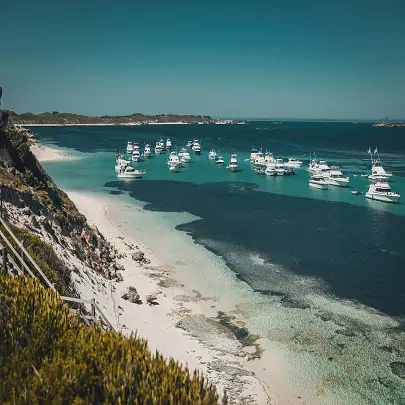
For those of you who have been to Hamelin Bay (and seen the old remains of the jetty), you may have seen that the bay is protected from the south by Hamelin Island, but other than that, the bay is quite unprotected and is open to gails and storms coming in off the Indian ocean.
One particular storm, on 22 July 1900, caused grief for three ships that were moored at the jetty.
The Katinka had come from South Africa for jarrah. However, after arriving at Western Australia, three of the crew members had deserted. This apparently left the ship too short on sailors to set sail again, so the captain had gone to Bunbury to try and find some replacements. He wasn't there on the night of the 22nd to see his ship suffer at the hands of a strong storm that blew in.
During the storm, the ship separated from it's mooring and was blown northwards, eventually striking the ground about half a kilometre off shore. The crew that were onboard tried to deal with this in different ways - some successfully and some not so. Five of the crew jumped overboard and tried to swim to shore in the pounding surf. Only two made it.
Those that remained on the ship were being tossed around as the sea battered the stricken vessel. An apprentice was knocked overboard and drowned, and the chief officer was killed when he was struck by a falling piece of timber that had broken off the mast.
While all this was going on, a Norwegian ship by the name of Lovspring was also moored at the jetty. Like the Katinka, she was also separated from her moorings, and was then blown onto Mushroom rock. As she quickly sank, the sailors climbed onto the rigging to escape the roaring waves.
The third ship to come unstuck was the Danish Norwester, which was blown onto the shore, narrowly missing the wreck of another ship that had met it's demise there just 3 months earlier.
It was mayhem.
As the waves eventually calmed, the surviving sailors of all three vessels were rescued from their ships or the rigging and other remains they were clinging to.
The Norwester was later successfully refloated and then towed to Fremantle for repairs, but the other two never sailed again - their remains were sold at auction for 2 pounds 10 shillings (Katinka) and 27 pounds (Lovspring).
Visiting the area today, you can easily miss any evidence of that stormy night, or even of the once popular timber port. Some relics are still there - the crumbling remains of the wooden jetty, the anchor from the Lovspring which is displayed at the Hamelin Bay car park, and at the Karridale cemetery you'll find the graves of four of the sailors from the Katinka who lost their lives that night.
While researching my dad's side of the family I found out that my great grandfather was a sea captain/harbour master at Hamelin.I found this out by reading the death certificates of his children.Two of them were born in Hamelin Bay in the late 1880's.One of the children born there has Hamelin as his middle name. Here I was thinking that Hamelin was something to do with WALES(Welsh background).